

A | 据媒体最新报道,韩国存储芯片巨头SK海力士的工会成员周二投票否决了一项经过两个月谈判达成的初步薪资协议,超过50%的投票者投出反对票。 Following Hamas' attack on Israel, the United States has sent a clear message of deterrence to prevent the conflict from spreading.To "anyone thinking of taking advantage of this situation," President Joe Biden said during an address on Tuesday, "I have one word: Don't."The rhetoric has since been repeated by others in the administration, with National Security Advisor Jake Sullivan telling reporters that they believe militia groups across the region "pose an urgent threat" and could "choose to try to exploit" the situation.On ABC News Live at 8:30 p.m. on Thursday, Oct. 12, ABC News' James Longman, Matt Gutman and Ian Pannell look at the horrendous toll from Hamas' massacre, the Israelis and Palestinians caught in the middle and what comes next."We have been sending clear warnings that doing so will result in a firm response and consequences from the United States," Sullivan said Tuesday.National Security Council spokesman John Kirby told reporters Wednesday there's a "long list of actors in the region that are hostile to Israel," including Hezbollah, the Iran-backed Lebanese militant group.The administration has also offered its full support to Israel, with Defense Secretary Lloyd Austin telling reporters in Brussels on Thursday that the U.S. is not placing conditions on the military aid it's providing to Israel. The U.S. additionally moved a carrier strike group into the eastern Mediterranean as part of its deterrence measures."We're sending a loud and clear message: The United States is ready to take action should any actor hostile to Israel consider trying to escalate or widen this war," Kirby said Wednesday.How impactful those gestures will be on the raging war remains uncertain. The U.S. has limited leverage in the region, though does need to be careful to not further escalate the conflict, foreign policy experts said. The Biden administration is also likely keen to not get heavily involved, experts said."If Hezbollah or the Islamic Revolutionary Guard Corps or some other militant group from a neighboring country decides to get involved and attack Israel at this time, I don't think the United States is going to do anything more than it's currently doing -- which is offering Israel whatever it needs to defend itself," Ralph Carter, a professor of political science at Texas Christian University, told ABC News.Biden has historically been "cautious" in sending U.S. troops into battle, Carter said. "His experience in Washington over 40 years or more suggests that once you start something like that, you have no idea where it's going to end."Kirby said Thursday that there are no active plans or intentions to send U.S. troops to join a potential ground war in Israel and Gaza. The U.S. has deployed its largest carrier group, the USS Gerald R. Ford, to the region as an act of deterrence, officials said."The United States has moved military assets in the region, but I really do find it doubtful that the Biden administration really wants to get heavily involved militarily," Russell Lucas, a professor of international relations and global studies at Michigan State University, told ABC News.Israel's powerful military is also capable of defending itself against Hamas and other militant groups, experts noted, which may limit what it needs from the U.S. and act as another deterrent."The requirements on the U.S. defense industry I think are maybe not as heavy as they might be if we were talking about a weaker ally," Adria Lawrence, the Aronson Associate Professor of International Studies and Political Science at Johns Hopkins University, said during a public briefing on the conflict.In recent days there have been some limited military engagements on Israel's northern border with Lebanon, though Hezbollah may be deterred from getting drawn into a larger conflict with Israel, experts said."They will pay dearly for entering the conflict," Lucas said. "I think most actors [in the region] know that at the end of the day, the most military-capable actor is Israel, so there is a deterrence factor."Given Israel's known military prowess, the Biden administration's rhetoric may be stronger than necessary, Lucas said."I think it's more the Biden administration is aiming especially at the domestic audience -- trying to reassert that kind of bully pulpit of the commander-in-chief role, especially in the face of perhaps critiques from the Republican Party that Biden isn't strong enough," he said.At the same time, the U.S. does need to be careful about making any threats, experts said."Words matter and if President Biden's making a commitment and making kind of an implicit threat, he needs to remember the risks that are inherent in making a red line," Lucas said. "President Obama's red line in Syria -- do not use chemical weapons -- that was then not followed up was viewed as one of Obama's biggest foreign policy failures."Sarah Parkinson, the Aronson Assistant Professor of Political Science and International Studies at JHU, said during the university's briefing that these comments by U.S. officials "will likely embolden extremists on both sides" and prolong the conflict.Following Biden's remarks, Hezbollah said they will not back down and are "ready for confrontation," while the top leader of the Islamist armed organization Houthis in Yemen said that if the U.S. intervenes militarily in Gaza, they will send munitions and fighters to support Hamas.In efforts to deescalate the conflict, the U.S. could help mobilize other countries in the region, according to James Steinberg, the dean of the School of Advanced International Studies at JHU and former Deputy Secretary of State during the Obama administration."It's not that the United States itself is going to broker a resolution of this, but it can engage others, all of whom have a stake in not seeing the situation escalate," Steinberg said during the university's briefing, noting the discussions that have been taking place between the U.S. and Saudi Arabia, the UAE and others.Secretary of State Antony Blinken told reporters Thursday at a press conference in Israel that they are working with their partners in the region to ensure "that there will not be a second front or a third front."Steinberg said a wider war "can't be ruled out," and the effectiveness of the U.S.' response to deescalate is "uncertain" -- likening it to its support of Israel in 1973 during the Yom Kippur War."Here as then, the United States has limited impact and limited leverage," he said. "Perhaps even less so today than it did in 1973."。

B |
据悉,在参与投票的15045名员工中,有50.08%的人反对该协议。赞成票和反对票之间的差距仅为25票。

C | SK海力士管理层与工会预计将恢复谈判,后续讨论的重点很可能围绕绩效奖金支付制度展开,而这正是劳资双方的核心分歧点所在。 不少员工反对超过一半的奖金以股票形式发放,因为他们对SK海力士股价的波动性感到担忧。

D | 该股6月曾在AI热潮的推动下创下历史新高,但随后因市场担忧AI巨额投入可能无法获得相应回报而大幅回调。

E | 上周,SK海力士与其工会就2026年度薪资及集体谈判达成初步协议。这项协议包括6.3%的薪资增长,以及对SK海力士利润分享奖金计划的调整:其中40%的奖金以现金形式发放,60%以公司股份形式发放,而此前为全部由现金支付。

F | 在该初步协议下,奖金总额的40%将在当年以现金形式发放;其余60%以公司股票形式发放,其中占总奖金40%的股票可在当年自由变现,剩余20%的股票则递延发放。 去年,SK海力士劳资双方约定取消利润分红上限,规定每年提取营业利润的10%作为奖金池,并设定为80%当年现金支付、20%递延两年以现金支付的发放机制。 作为全球第二大存储芯片制造商,SK海力士正凭借人工智能应用对高带宽存储器(HBM)芯片的旺盛需求持续获得丰厚利润。随着利润暴涨,SK海力士员工希望获得更高的奖金,股东则期待分红、回购等资本回报。 SK海力士上周宣布,其董事会已批准一项决议,拟回购并注销价值40万亿韩元(约合283亿美元)的股票。

G | 此举旨在将公司凭借AI浪潮所获得的丰厚收益回馈给投资者。 周二,SK海力士股价大跌,截至发稿,下跌4.55%,报1595000韩元,盘中跌幅一度接近7%。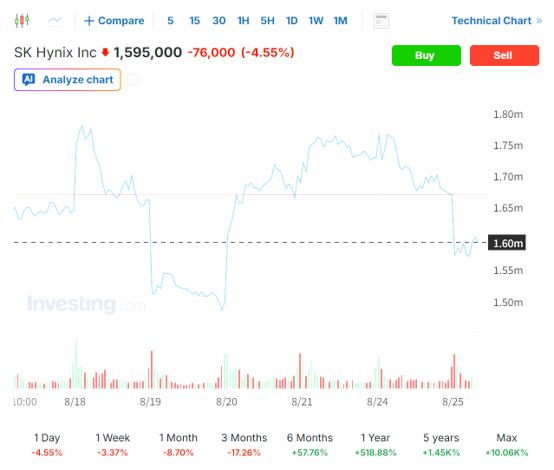 美国芯片股抛售潮也波及了韩国芯片股。截至发稿,三星电子股价下跌约2%。 由于英伟达财报发布前市场谨慎情绪升温,隔夜美股市场,美光科技和闪迪等芯片厂商股价暴跌。
 (文章来源:财联社)。
Current article:http://tdy2o.dangnichuaitongjuanye.pics/news/20260826_1807.html
Published on:08:32:32

1至7月,2.06亿人次涌进武林商圈 老商圈解锁AI新玩法(图)
向幸福出发功夫足球痞子英雄...


